Health apps can organize appointments, prescriptions, records, fitness data and teleconsultations. They can also collect information whose exposure affects more than a single account. A good privacy review therefore asks what the app needs for the chosen feature, who can receive the data, how long access lasts and how a person can withdraw consent or correct a record.
This guide is a practical decision framework for readers in India. Products, interfaces, prices, laws, policies and official procedures can change. Confirm time-sensitive details with the original provider or relevant authority before acting, especially when identity, health, money, rights or safety are involved.
A practical framework for health app privacy India
Start by naming the exact job, the people affected and the consequence of failure. Work through the checkpoints in order, write down the evidence and prefer a reversible test over a large commitment. A polished interface or confident claim is not proof; the important question is whether the choice remains understandable, supportable and recoverable in the reader’s real environment.
Name the health task before installing
A step counter, appointment tool, record wallet and symptom checker perform different jobs and do not need the same data. The task should determine the permission set and acceptable risk.
India context: Indian digital-health services can connect public infrastructure, hospitals, laboratories and private apps, so the provider and integration must be identified precisely. This India-specific checkpoint belongs in the main decision because access, support, language and day-to-day conditions can change the safest practical choice.
Action to take
Write the one feature you need, confirm the official publisher and compare whether a website or existing provider portal already solves it. Record the result beside the decision so another person can understand what was checked and why it mattered.
Common mistake: Installing several overlapping apps creates duplicate records, broader permissions and more accounts to protect without guaranteeing better care. Treat a confident claim as a prompt to verify, not as proof by itself.
Review permissions in context
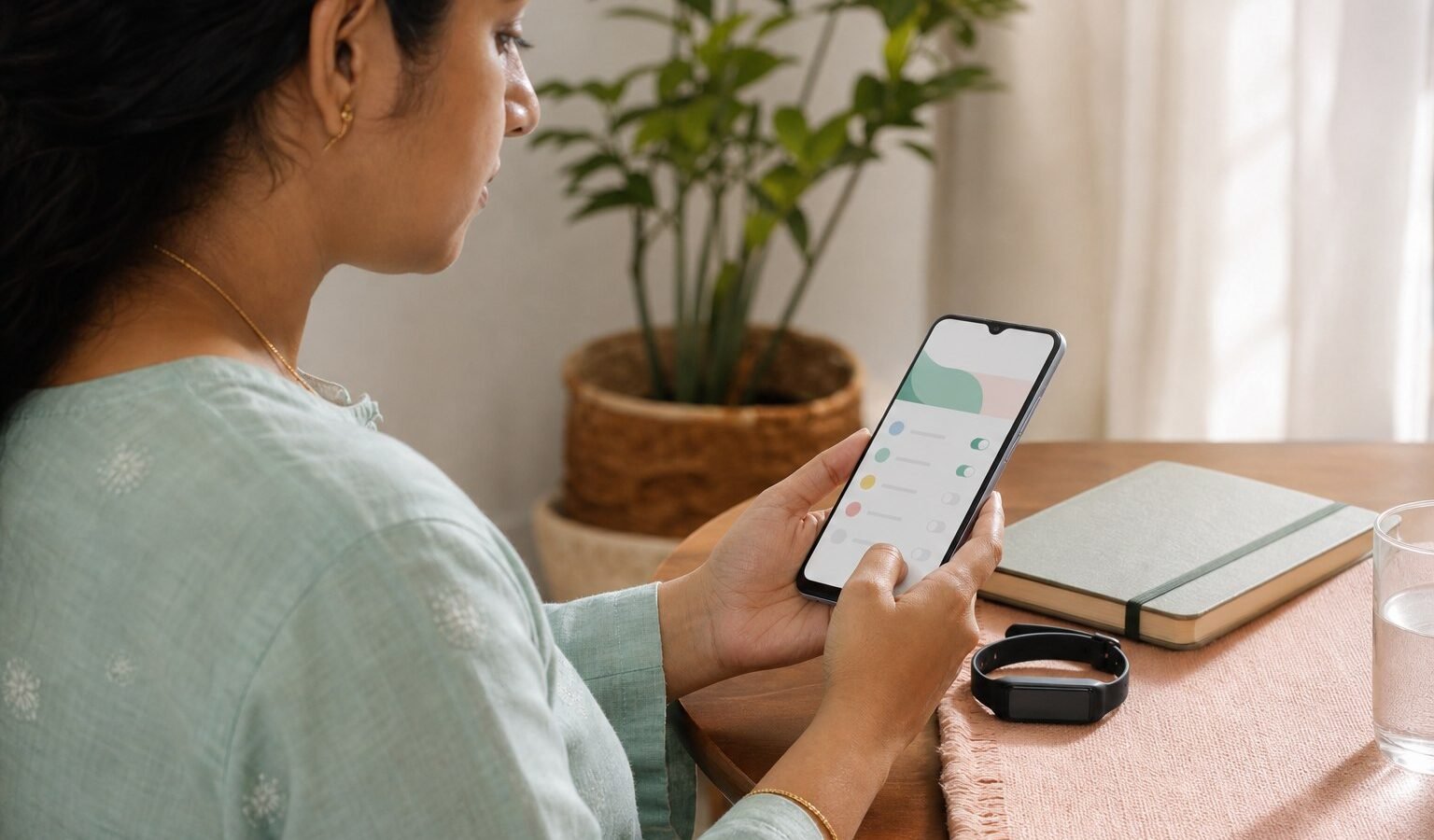
Camera access can scan a document, location can find a facility and Bluetooth can connect a wearable, but a valid use does not justify permanent access for every feature.
India context: Android versions, device brands and app updates can change how permission choices are presented to Indian users. Availability and usability are part of quality, so verify this detail before treating a broad recommendation as locally useful.
Action to take
Grant access only when using the feature, remove background permissions that lack a clear purpose and recheck after major updates. Keep the evidence, date and responsible person together; memory becomes unreliable when several options look similar.
Common mistake: Approving every permission during onboarding because the screen looks official weakens the value of consent. Treat a confident claim as a prompt to verify, not as proof by itself.
Distinguish wellness guidance from medical care
A score, alert or prediction can be useful context but may not be a diagnosis. The reliability depends on sensors, input quality, population, validation and the decision the output is used to make.
India context: Language, device quality, connectivity and access to follow-up care can influence how safely an app recommendation works in practice. A good answer makes the local constraint visible and shows which part of the decision needs fresh confirmation.
Action to take
Ask what evidence supports the output, what uncertainty remains and which symptom or threshold requires a qualified clinician. Use the result to remove unsuitable choices and define the smallest reversible next step.
Common mistake: Changing medication, delaying urgent care or interpreting an alarming score alone can create harm far beyond a privacy concern. Treat a confident claim as a prompt to verify, not as proof by itself.
Understand consent and record sharing
Consent should connect a defined recipient, purpose, data set and period. A broad button labelled continue is not a substitute for understanding the actual health-record flow.
India context: ABDM emphasizes consent-based sharing and a federated architecture, while individual apps may also operate their own services and policies. This India-specific checkpoint belongs in the main decision because access, support, language and day-to-day conditions can change the safest practical choice.
Action to take
Read the recipient and duration before approving, use available activity or consent records and withdraw access that is no longer needed. Record the result beside the decision so another person can understand what was checked and why it mattered.
Common mistake: Assuming that every service using a familiar national term is automatically an official government app can expose records to an impersonator. Treat a confident claim as a prompt to verify, not as proof by itself.
Protect linked devices and family profiles
Wearables, home monitors and family-management features can combine information about several people. The account owner should not assume that one person can consent for every adult in the household.
India context: Shared phones and caregiver access may be necessary, but roles should be limited to the minimum practical level. Availability and usability are part of quality, so verify this detail before treating a broad recommendation as locally useful.
Action to take
Use separate profiles where available, review connected devices, remove old wearables and keep screen-lock and recovery controls current. Keep the evidence, date and responsible person together; memory becomes unreliable when several options look similar.
Common mistake: Leaving a sold or borrowed wearable connected can continue syncing data or reveal account notifications to another person. Treat a confident claim as a prompt to verify, not as proof by itself.
Prepare for correction, export and deletion
A useful health record must be accurate and portable enough for the person to understand what is stored. Correction and deletion rights may have limits when providers must retain clinical or legal records.
India context: Health data can sit with the facility, app, laboratory, insurer or an interoperable service rather than one central database. A good answer makes the local constraint visible and shows which part of the decision needs fresh confirmation.
Action to take
Identify the data controller, use its grievance or correction route and retain copies of clinically important records before closing an account. Use the result to remove unsuitable choices and define the smallest reversible next step.
Common mistake: Deleting the app from a phone does not prove that provider records, backups or lawful retention copies were erased. Treat a confident claim as a prompt to verify, not as proof by itself.
A simple decision scorecard
| Checkpoint | Question | Evidence to keep |
|---|---|---|
| Purpose | What exact job must this choice complete? | A one-sentence requirement and a real test. |
| Access | Who or what receives permission? | A current account, device and permission list. |
| Trust | Which important claims can be verified? | Dated primary documents or official guidance. |
| Failure | What happens when the service, device or account fails? | A tested fallback and named recovery owner. |
| Exit | Can data, access and payment be removed cleanly? | Export, revocation, deletion and support steps. |
A scorecard does not replace judgement. It makes assumptions visible and gives a family, student, traveller or small team a shared record. If two options are close, prefer the one that is easier to test, understand, maintain and leave. Reversibility has real value when technology and guidance change.
Official sources and further reading
The practical guidance above is grounded in these primary or official sources. Open the current version before making a high-consequence decision because policies, interfaces and enforcement timelines can change.
Frequently asked questions
Does every health app need location access?
No. Location may support a nearby-service or emergency feature, but many record, appointment and education functions can work without continuous access.
Can a fitness tracker diagnose a disease?
Consumer wearables can offer useful signals, but an alert is not automatically a clinical diagnosis. Discuss concerning results and symptoms with a qualified professional.
Is ABHA participation voluntary?
ABDM policy describes participation as voluntary. Check the current official policy and the specific service workflow before giving consent.
What is the safest way to share a health report?
Use the provider or official consent-based route where possible, confirm the recipient and purpose, and avoid forwarding an unrestricted file through an unverified chat.
The Ucatru view
Digital trust is a repeatable habit: verify the source, grant the minimum access, keep important evidence and know the recovery path before trouble starts. The most useful choice is not the one with the longest feature list. It is the one whose purpose is clear, whose risks are visible and whose failure can be contained without unnecessary harm.
Editorial note: This article provides general educational information for readers in India. It does not provide medical, legal, financial or other individual professional advice. Where a decision affects health, safety, rights or substantial money, consult an appropriately qualified professional and the latest official information.