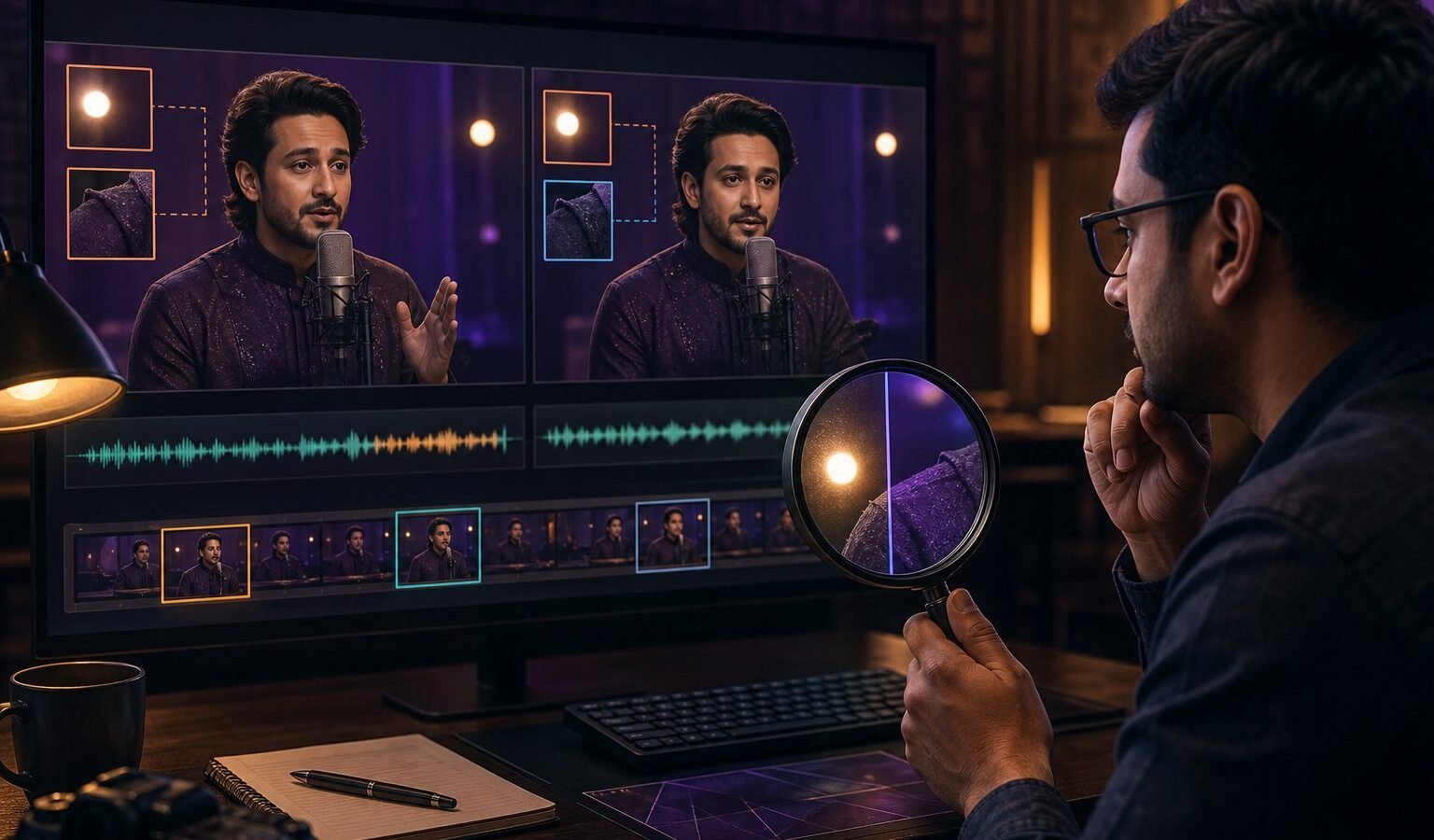
A convincing face or voice is no longer enough to prove that a celebrity made a statement, endorsed a product or appeared in an event. Synthetic media can imitate identity while reposting strips away the original context. Verification should therefore begin with provenance and corroboration rather than a hunt for one visual glitch.
This guide is a practical decision framework for readers in India. Products, interfaces, prices, laws, policies and official procedures can change. Confirm time-sensitive details with the original provider or relevant authority before acting, especially when identity, health, money, rights or safety are involved.
A practical framework for deepfake celebrity video verification India
Start by naming the exact job, the people affected and the consequence of failure. Work through the checkpoints in order, write down the evidence and prefer a reversible test over a large commitment. A polished interface or confident claim is not proof; the important question is whether the choice remains understandable, supportable and recoverable in the reader’s real environment.
Separate the media file from the claim
A real video can carry a false caption, and a synthetic clip can include accurate background details. Verification must test both what the media shows and what the post claims it means.
India context: Celebrity endorsements, political statements, film announcements and financial promotions can have different legal and practical consequences in India. This India-specific checkpoint belongs in the main decision because access, support, language and day-to-day conditions can change the safest practical choice.
Action to take
Write the exact claim in one sentence and list the person, event, date, product and action that need confirmation. Record the result beside the decision so another person can understand what was checked and why it mattered.
Common mistake: Debunking one visual detail does not automatically resolve a different claim added by the caption or comments. Treat a confident claim as a prompt to verify, not as proof by itself.
Find the earliest and fullest version
Each repost can crop disclosures, remove audio, reduce quality and hide the account that first published the clip. The closest available source offers more useful context than the most viral copy.
India context: Short-video platforms and messaging apps can spread compressed versions quickly across languages and regions. Availability and usability are part of quality, so verify this detail before treating a broad recommendation as locally useful.
Action to take
Search key phrases, reverse-search representative frames and look for a longer version from the event, interviewer or official account. Keep the evidence, date and responsible person together; memory becomes unreliable when several options look similar.
Common mistake: Treating a watermark on a repost as proof of origin confuses the current uploader with the creator of the media. Treat a confident claim as a prompt to verify, not as proof by itself.
Check official and independent corroboration
A major endorsement, apology or announcement should usually leave evidence beyond one clip. Official statements and multiple independent reports can confirm the underlying event even when the media format is uncertain.
India context: A verified badge or familiar handle can be copied in screenshots, while compromised accounts can publish misleading content. A good answer makes the local constraint visible and shows which part of the decision needs fresh confirmation.
Action to take
Open the account directly, inspect its history and compare the claim with credible reporting or the organization named in the video. Use the result to remove unsuitable choices and define the smallest reversible next step.
Common mistake: Relying on dozens of reposts is not independent corroboration when every post traces back to the same unverified file. Treat a confident claim as a prompt to verify, not as proof by itself.
Inspect technical clues without overconfidence
Lip synchronization, lighting, reflections, blinking, hand detail, voice cadence and edge artifacts can raise questions, but modern generation and heavy compression can hide or create these clues.
India context: Low bandwidth, screen recording and repeated messaging compression often produce artifacts unrelated to synthetic generation. This India-specific checkpoint belongs in the main decision because access, support, language and day-to-day conditions can change the safest practical choice.
Action to take
Compare several frames, listen for abrupt audio changes and use available verification tools only as one layer of evidence. Record the result beside the decision so another person can understand what was checked and why it mattered.
Common mistake: Declaring a clip authentic because no obvious glitch appears gives visual inspection more certainty than it can support. Treat a confident claim as a prompt to verify, not as proof by itself.
Treat commercial requests as a separate risk
Fake celebrity media often leads to an investment, gambling, shopping or app-installation request. The financial destination must be checked even if the video remains technically unresolved.
India context: Indian users may encounter local payment handles, lookalike news pages and region-specific language designed to imitate a trusted endorsement. Availability and usability are part of quality, so verify this detail before treating a broad recommendation as locally useful.
Action to take
Search the product and company independently, confirm regulatory status where relevant and never pay through a link carried only by the viral post. Keep the evidence, date and responsible person together; memory becomes unreliable when several options look similar.
Common mistake: A recognizable person on screen does not transfer their reputation to an unrelated website, token, game or payment address. Treat a confident claim as a prompt to verify, not as proof by itself.
Preserve evidence and report responsibly
When impersonation, fraud, privacy abuse or unlawful synthetic content causes harm, a clear record can support platform review and an official complaint.
India context: India provides platform grievance mechanisms, the National Cyber Crime Reporting Portal and law-enforcement routes depending on the incident. A good answer makes the local constraint visible and shows which part of the decision needs fresh confirmation.
Action to take
Save the URL, account, date, screenshots and payment details without repeatedly distributing the harmful file. Use the result to remove unsuitable choices and define the smallest reversible next step.
Common mistake: Forwarding the clip to more groups while warning that it may be fake can still expand reach and harm the impersonated person. Treat a confident claim as a prompt to verify, not as proof by itself.
A simple decision scorecard
| Checkpoint | Question | Evidence to keep |
|---|---|---|
| Purpose | What exact job must this choice complete? | A one-sentence requirement and a real test. |
| Access | Who or what receives permission? | A current account, device and permission list. |
| Trust | Which important claims can be verified? | Dated primary documents or official guidance. |
| Failure | What happens when the service, device or account fails? | A tested fallback and named recovery owner. |
| Exit | Can data, access and payment be removed cleanly? | Export, revocation, deletion and support steps. |
A scorecard does not replace judgement. It makes assumptions visible and gives a family, student, traveller or small team a shared record. If two options are close, prefer the one that is easier to test, understand, maintain and leave. Reversibility has real value when technology and guidance change.
Official sources and further reading
The practical guidance above is grounded in these primary or official sources. Open the current version before making a high-consequence decision because policies, interfaces and enforcement timelines can change.
- PIB: India response to deepfakes and evolving online harms
- MeitY/PIB: 2026 framework for synthetically generated information
Frequently asked questions
Can a deepfake always be detected by looking at the eyes?
No. Visual artifacts are inconsistent and compression can create false clues. Source provenance and independent corroboration are more dependable starting points.
Does a verified social account prove the clip is genuine?
Not by itself. Accounts can be compromised and screenshots can be fabricated. Open the account directly and check the broader context.
Should I share a suspicious video to ask friends if it is fake?
Avoid redistributing the file. Share a description or a trusted fact-check link after verification so the harmful content does not gain more reach.
Where can cybercrime involving a deepfake be reported in India?
Use the relevant platform grievance route and, where a cybercrime may have occurred, the official National Cyber Crime Reporting Portal or local law enforcement.
The Ucatru view
Digital trust is a repeatable habit: verify the source, grant the minimum access, keep important evidence and know the recovery path before trouble starts. The most useful choice is not the one with the longest feature list. It is the one whose purpose is clear, whose risks are visible and whose failure can be contained without unnecessary harm.
Editorial note: This article provides general educational information for readers in India. It does not provide medical, legal, financial or other individual professional advice. Where a decision affects health, safety, rights or substantial money, consult an appropriately qualified professional and the latest official information.