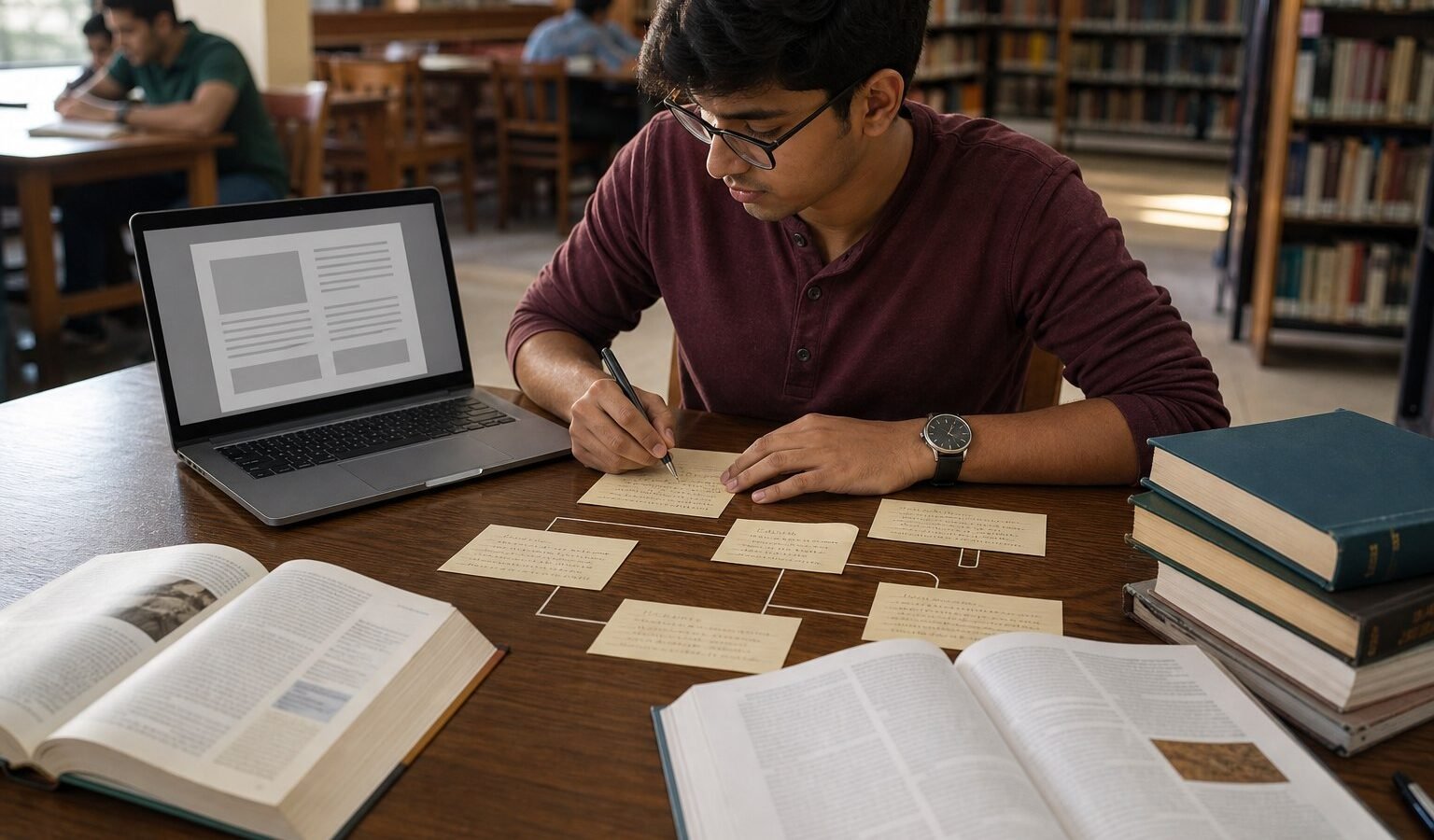
Search results provide access, not a conclusion. A student still needs to define the question, distinguish primary evidence from summaries, check dates, read beyond a quoted sentence and show where each important claim came from. These digital research skills improve assignments, projects and everyday decisions even when an AI tool helps discover possible sources.
This guide is a practical decision framework for readers in India. Products, interfaces, prices, laws, policies and official procedures can change. Confirm time-sensitive details with the original provider or relevant authority before acting, especially when identity, health, money, rights or safety are involved.
A practical framework for digital research skills Indian students
Start by naming the exact job, the people affected and the consequence of failure. Work through the checkpoints in order, write down the evidence and prefer a reversible test over a large commitment. A polished interface or confident claim is not proof; the important question is whether the choice remains understandable, supportable and recoverable in the reader’s real environment.
Convert the topic into a researchable question
A broad topic produces an unmanageable pile of material. A useful question names the population, concept, period and relationship the student intends to examine.
India context: Indian assignments may require national evidence, a specific state comparison or a locally defined policy period, so geography and date belong in the question. This India-specific checkpoint belongs in the main decision because access, support, language and day-to-day conditions can change the safest practical choice.
Action to take
Write one main question, three subquestions and the evidence that would count as an answer before searching. Record the result beside the decision so another person can understand what was checked and why it mattered.
Common mistake: Collecting sources first and inventing the question later encourages cherry-picking and a report with no clear argument. Treat a confident claim as a prompt to verify, not as proof by itself.
Use search terms that reveal source type
Adding a ministry, regulator, dataset, report, journal or file type to a query helps locate original material rather than endless recycled summaries.
India context: Government names and programme titles can change, and a central policy may be implemented differently by states or institutions. Availability and usability are part of quality, so verify this detail before treating a broad recommendation as locally useful.
Action to take
Search the exact programme or rule name, open the publishing organization and inspect its date, scope and document status. Keep the evidence, date and responsible person together; memory becomes unreliable when several options look similar.
Common mistake: The first result can be popular because it is optimized or widely linked, not because it is the strongest evidence for the question. Treat a confident claim as a prompt to verify, not as proof by itself.
Read laterally before trusting a source
Lateral reading means leaving the page to investigate who publishes it, what expertise or interest they have and whether other credible sources confirm the document.
India context: A website can use an official-looking colour scheme or a domain containing familiar public terms without belonging to the responsible authority. A good answer makes the local constraint visible and shows which part of the decision needs fresh confirmation.
Action to take
Check the domain, about page, author, references and independent descriptions before relying on a claim. Use the result to remove unsuitable choices and define the smallest reversible next step.
Common mistake: Spending ten minutes reading a persuasive page without checking its publisher can make weak evidence feel stronger through familiarity. Treat a confident claim as a prompt to verify, not as proof by itself.
Trace numbers and quotations to context
A statistic may describe a different year, sample or definition than the student assumes. A quotation can change meaning when the surrounding paragraph or exception is removed.
India context: India-wide averages can hide state, rural-urban, gender, language or income differences that matter to the assignment. This India-specific checkpoint belongs in the main decision because access, support, language and day-to-day conditions can change the safest practical choice.
Action to take
Record the exact table, page, definition, sample and publication date beside every important number or quotation. Record the result beside the decision so another person can understand what was checked and why it mattered.
Common mistake: Citing the article that repeated a number rather than the report that produced it makes errors harder to detect and correct. Treat a confident claim as a prompt to verify, not as proof by itself.
Build notes around claims, not documents
A folder of PDFs does not show which source supports which sentence. Claim-level notes connect a proposition, evidence, limitation and citation while the reasoning is still visible.
India context: Students may switch between a phone, library computer and shared laptop, so a lightweight, exportable note format is safer than a fragile app-only workflow. Availability and usability are part of quality, so verify this detail before treating a broad recommendation as locally useful.
Action to take
Create a table with claim, source, quotation or data, interpretation, limitation and citation fields. Keep the evidence, date and responsible person together; memory becomes unreliable when several options look similar.
Common mistake: Copying paragraphs into notes without quotation marks creates accidental plagiarism when the wording later feels like the student own. Treat a confident claim as a prompt to verify, not as proof by itself.
Use AI as a research assistant, not an authority
AI can suggest vocabulary, counterarguments or possible sources, but a fluent answer does not prove that a cited document exists or supports the statement.
India context: Policies, court decisions, scheme rules and examination requirements in India can change after a model training period or differ across jurisdictions. A good answer makes the local constraint visible and shows which part of the decision needs fresh confirmation.
Action to take
Open every source, verify the relevant passage and disclose material AI use when the teacher or institution requires it. Use the result to remove unsuitable choices and define the smallest reversible next step.
Common mistake: Submitting generated analysis without understanding or attribution weakens learning and may violate academic-integrity rules. Treat a confident claim as a prompt to verify, not as proof by itself.
A simple decision scorecard
| Checkpoint | Question | Evidence to keep |
|---|---|---|
| Purpose | What exact job must this choice complete? | A one-sentence requirement and a real test. |
| Access | Who or what receives permission? | A current account, device and permission list. |
| Trust | Which important claims can be verified? | Dated primary documents or official guidance. |
| Failure | What happens when the service, device or account fails? | A tested fallback and named recovery owner. |
| Exit | Can data, access and payment be removed cleanly? | Export, revocation, deletion and support steps. |
A scorecard does not replace judgement. It makes assumptions visible and gives a family, student, traveller or small team a shared record. If two options are close, prefer the one that is easier to test, understand, maintain and leave. Reversibility has real value when technology and guidance change.
Official sources and further reading
The practical guidance above is grounded in these primary or official sources. Open the current version before making a high-consequence decision because policies, interfaces and enforcement timelines can change.
- National Digital Library of India
- UGC: Promotion of Academic Integrity and Prevention of Plagiarism Regulations
Frequently asked questions
Is Wikipedia acceptable in student research?
It can help discover vocabulary and references, but important claims should normally be verified and cited from the original or institution-approved source.
How can a student tell whether a source is primary?
Ask whether it presents the original law, dataset, experiment, policy, speech or record rather than only describing another publication.
Can AI-generated citations be trusted?
No. Open every citation, confirm that it exists and verify that the exact page or section supports the claim.
What is the simplest note-taking system?
A spreadsheet or document table with claim, evidence, source, limitation and citation fields is sufficient if it is used consistently and backed up.
The Ucatru view
Digital trust is a repeatable habit: verify the source, grant the minimum access, keep important evidence and know the recovery path before trouble starts. The most useful choice is not the one with the longest feature list. It is the one whose purpose is clear, whose risks are visible and whose failure can be contained without unnecessary harm.
Editorial note: This article provides general educational information for readers in India. It does not provide medical, legal, financial or other individual professional advice. Where a decision affects health, safety, rights or substantial money, consult an appropriately qualified professional and the latest official information.